
Where metal contamination comes from
Even well-run food plants face the risk of metal finding its way into product. Common sources include worn blades and screens, loose fasteners, wire from cleaning tools and contaminants carried in with raw ingredients. A single incident can lead to a product recall, so most manufacturers place at least one metal detection point on every line.
How a conveyor metal detector works
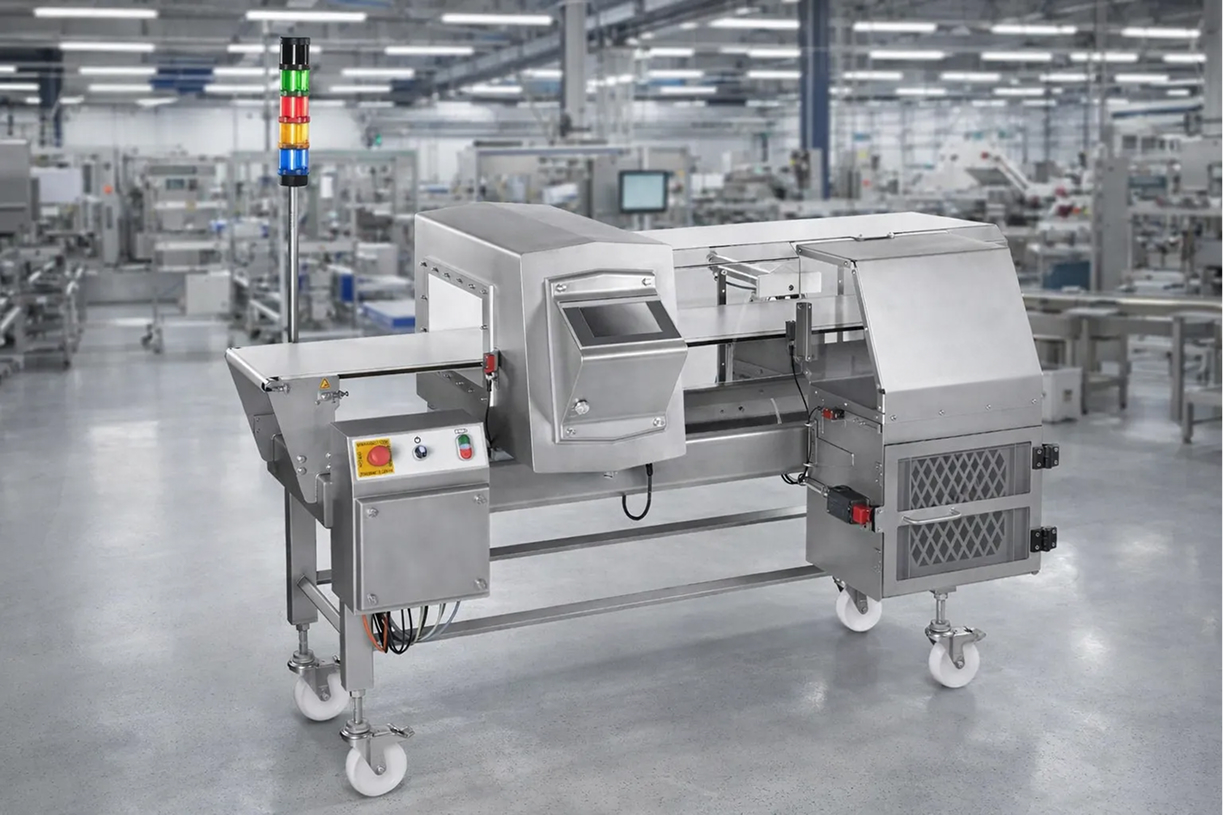
Most industrial food metal detectors use a balanced coil system. A transmitter coil creates a high-frequency field inside the aperture, and two receiver coils sit on either side of it. When nothing is passing through, the signals from the receivers cancel each other out. When a piece of metal passes through the aperture it disturbs the field, the balance is broken and the detector raises a signal.
The detector then triggers a reject device, such as an air blast, pusher arm or retracting belt, to remove the affected pack from the line without stopping production.
Dealing with product effect
Some foods are themselves conductive. Products that are wet, salty or frozen-then-thawing, such as meat, cheese or ready meals, can produce a signal similar to metal. Modern detectors learn this "product effect" during set-up and use multi-frequency or phase-based processing to tell the difference between the product and a genuine contaminant.
Getting the most from your detector
- Choose the smallest aperture that comfortably fits the pack, because sensitivity is higher in a smaller opening.
- Inspect as late in the process as practical, ideally after final packing.
- Test regularly with certified ferrous, non-ferrous and stainless-steel test pieces and keep records.
- Make sure the reject system and a lockable reject bin are working as part of every check.
If your product is packed in metallised film or foil trays, or you need to find dense non-metallic contaminants such as glass or stone, X-ray inspection may be the better choice. Our team can help you compare the options for your application.